

Changing Lives,
Strengthening Systems
The Legacy of PEPFAR-Supported HIV Services in the Dominican Republic
FY 23–26
Choose a section
Move through the platform in order, or open any section directly.
Project overview
Select a province to see its partners and supported facilities.
Hover over any highlighted province to see the CBOs/FBOs working there and its clinical sites. Click or tap to keep the panel open; press Esc to close. The key button opens the project totals.
Enhanced HIV Services for Epidemic Control (EHSEC) is a project funded by the U.S. President’s Emergency Plan for AIDS Relief (PEPFAR) through the Department of State of the United States of America, with a period of performance from October 1, 2022 to September 30, 2026 (FY23–26*).
Address remaining barriers to PEPFAR’s 95-95-95 targets and promote self-sufficient management of HIV projects in the Dominican Republic.
At-risk adult men, women, and people living with HIV.
Lifesaving HIV prevention, testing, care and treatment services.
20 health facilities (11 public facilities and 9 community-based and faith-based organisation-led clinics) and the surrounding communities, through 10 CBO/FBO partners in 7 provinces: Santo Domingo, National District, Monte Plata, La Romana, San Pedro de Macorís, Puerto Plata and Valverde.
* The fiscal year runs from 1 October to 30 September.
Key program results
99% HIV treatment initiation
18% growth of the treatment cohort
93% HIV viral load suppression
Innovations
Harnessing innovations and evidence-based approaches to accelerate impact, improve efficiencies and strengthen HIV program outcomes.
HIV Testing Services
Index testing reached partners and biological children of people living with HIV (PLHIV) with HIV testing services and identified about 1,500 new PLHIV at 25% case finding — this success was driven by hybrid testing that nested a social network testing strategy into index testing.
Digital health reached about 350 new PLHIV at 8% case finding through cyber-educators using social media to penetrate at-risk networks.
Community led testing reached about 5,000 new PLHIV at 5% case finding through the engagement of community leaders and the mobilization of at-risk social networks.
Our success with the Digital EPOA and cyber-education strategies comes from following every planned process, turning the tools FHI 360 provided into resources that let at-risk men and women feel heard, protected and accompanied at every step toward their diagnosis.
We try to connect with community organizations such as churches, neighborhood associations, social clubs, and schools, among others, that work within the community and surrounding sectors… they are contacted through activities that we carry out. To select the candidates within these organizations, we take into account that they have a calling for service, that they are a ‘leader’ with experience and have already done work within the community… on average we can say that these leaders can refer up to 30 PP a week.
HIV Treatment Retention
Client-centered antiretroviral treatment (ART) case management built on a peer-led approach, virtual platforms and client risk segmentation achieved 98% retention among at-risk women and men living with HIV.
Clinical cases multidisciplinary review and death audit improved quality of care, reduced preventable deaths and strengthened clinical outcomes.
Learning Club and virtual platforms for peer-to-peer consultations on complex clinical cases provided an opportunity for health care providers to connect and share expertise through a continuous learning network that built capacity and improved quality of care.
It fills me with joy to know that thanks to my efforts every patient can have their medication to hand, and that helps them stay healthy.
We track appointments through an appointment book that is checked every day. Calls are then made to those with an appointment within 48 hours and the promotors provide additional reminders. We try to ensure that the pills do not run out on the same day of the appointment in case some mishap occurs, and we cannot connect with them on that day. An average of 80 to 100 PP are supported at Yolanda Guzmán weekly with a team of 20 ART promoters.
Strengthening systems
Strengthening health systems, local capacity and workforce to sustain high-quality HIV services and long-term impact.
CBO/FBO Capacity Strengthening
Scores are measured on a 0–4 scale using the organizational capacity assessment applied at baseline (February 2023) and endline (September 2026). Hover or focus a domain to see its increase.
increase in overall organizational capacity performance
Average score improved from 2.0 to 3.2 across five institutional capacity domains between 2023 and 2026.
Teamwork, strict adherence to the standards and rigorous compliance with every process are our most powerful tools for achieving coverage and viral suppression among our clients — making this technical effort, supported by FHI 360, a sure way to save lives.
Data That Drives Impact
EHSEC footprint in strengthening HIV global health results
High-quality data and effective data use are fundamental to the success, accountability, sustainability and ultimately to the progress toward ending HIV as a public health threat by 2030.
EHSEC supported the use of reliable, timely, complete, and disaggregated data to identify gaps, prioritize populations and geographic areas with the greatest need, allocate resources efficiently, monitor performance, and demonstrate measurable results.
EHSEC strengthened the capacity of local partners and national health systems to collect, analyze, interpret, and use quality data to improve HIV program performance, demonstrating value for U.S. investments.
With technical support from FHI 360 we optimised CD4 testing coverage by implementing standardised clinical protocols, which give us timely immunological assessment to guide our clients’ care safely, and save lives.
Driving Performance Through Adaptive Leadership
Engagement closer to sites
Co-creation of approaches to address challenges
Micro-level target setting
Gap analysis and remedial action plan
Mutual accountability
Implementation fidelity
Improved outcomes
EHSEC supported the Total Quality Leadership and Accountability (TQLA) strategy as an innovative and adaptive management approach that:
This quality improvement model allows action planning based on the use of data for decision making and the analysis of the processes involved in each of the services of the HIV cascade. For example, in the previous quarter (Q3) although we showed significant improvements, we were not able to reach 95 percent coverage or suppression among PP and there was a need to continue to act. We integrated people into our quality team, ensuring the participation of the ART promoter coordinator, ART doctors, psychologists, the monitoring and evaluation officer and the digital clerk. We will continue to use this model moving forward.
Partnerships & country ownership
Strengthening country-led partnerships and systems to sustain impact, accelerate progress, and advance locally owned HIV responses.
Advancing Ministry of Health Leadership and Technical Capacity
Supported the government of the Dominican Republic to improve health outcomes through the following activities:
Enhancing data systems for community testing and impact
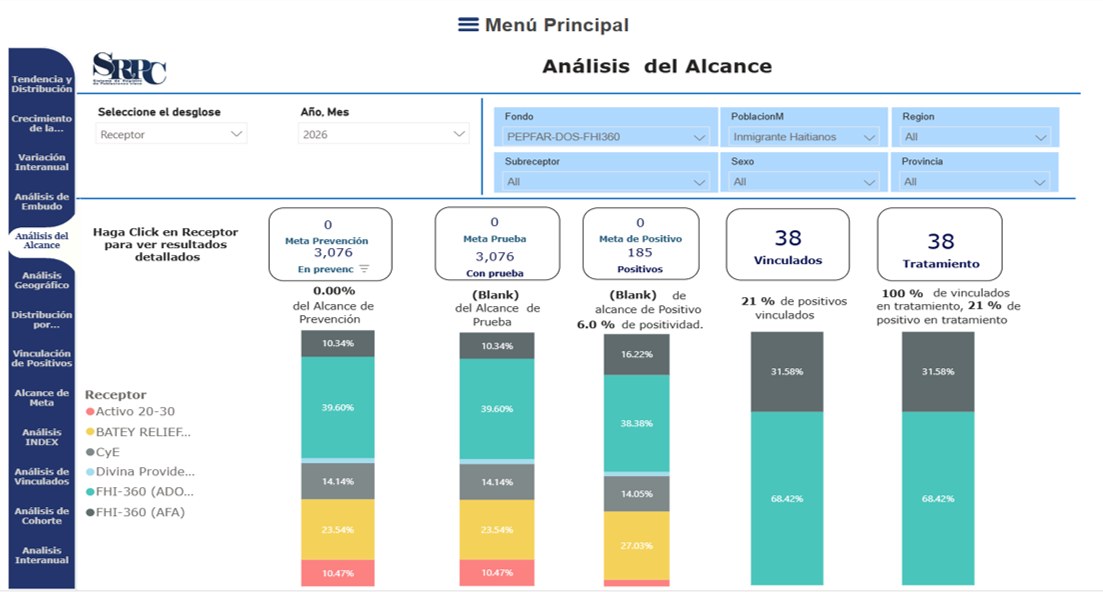
With the aim of eliminating parallel data sources and strengthening the use of national systems, the project began using the national community registry system (SRPC) in May 2026, in coordination with CONAVIHSIDA.
Accelerating Tuberculosis Preventive Treatment Scale-up
Worked with the National TB Program to secure tuberculosis preventive treatment (TPT) medications, and with the HIV Program to raise TPT completion to 97%, by engaging HIV teams to set and meet monthly TPT completion targets.
People living with HIV initiating and completing tuberculosis preventive treatment. Between the two periods initiations rose by 62% and completions by 146%.
Stories of change
Highlighting the people, partnerships and experiences behind meaningful change and lasting results.
Sharing Knowledge
Peer-reviewed publications
Integration of a social network strategy into index testing to increase HIV case finding among Haitian migrants and their descendants in the Dominican Republic
Evaluation of an HIV-related Education Intervention Scale-up: A Hybrid Type 3 Effectiveness-implementation Study in the Dominican Republic
Iterative client-centered design of antiretroviral therapy interventions among Haitian migrants and descendants living with HIV in the Dominican Republic: program development, description, and implications
International AIDS Society conference posters
FHI 360 Impact Report
 FHI 360 Impact Report 2026
Trusted voices online are connecting people to HIV services — the EHSEC cyber-educator story.
Read on fhi360.org
Voices of Impact
Bringing results to life through the voices, experiences and achievements of the people and the communities we served.
Success Stories FY23–FY25
Select a document to read it.
Estrellas del Impacto FY26
Select an edition to read it.
Toward the next phase
The voices of the people the project served, and a look back across four years of work.
Acknowledgements
This resource is made possible by the generous support of the American people through the U.S. Department of State. The contents are the responsibility of the Enhanced HIV Services for Epidemic Control (EHSEC) project and do not necessarily reflect the views of the U.S. Department of State or the United States Government. EHSEC is a cooperative agreement (72051722CA00002) led by FHI 360 in the Dominican Republic.